How we compute
Numerical methods
Spectral/hp element methods combine the geometric flexibility of finite elements with the accuracy of spectral methods. We work on the discretisations themselves: how to make them stable, how to place resolution where it is needed, and how to couple parts of a simulation that do not line up.
Most engineering simulation uses low-order methods, where accuracy is improved by adding more elements to the mesh. High-order methods instead offer an alternative route of enrichment: we raise the polynomial degree within each element, so that accuracy improves far faster for the same number of degrees of freedom. For the unsteady, vortex-dominated flows we simulate, that difference is what makes a simulation far more affordable: low-order schemes damp the very structures being studied.
The catch is that high-order methods are less forgiving: aliasing errors (that a dissipative scheme would quietly absorb) can destabilise a simulation entirely; boundary conditions that seem innocuous can degrade the order of accuracy; and the choice between continuous and discontinuous formulations changes the computational cost of the whole simulation. A good deal of our work is on these questions of stability and formulation, including comparisons that establish where each approach is actually the right one rather than assuming it.
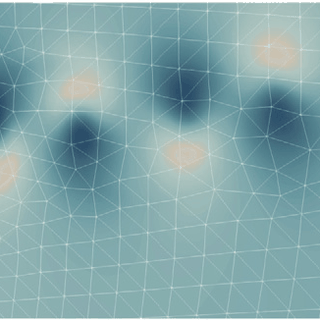
Two threads are particularly active within our group. Adaptivity asks where the resolution should go: whether to refine the mesh, raise the polynomial order, or move the points that are already there, and how to decide automatically. Non-conformal interfaces deal with the case where two parts of a simulation meet without matching up, which is what happens whenever geometry slides or rotates relative to the rest of the domain, as in turbomachinery. Getting the flux across such an interface right, without losing accuracy or conservation, is a surprisingly delicate problem and one we have returned to repeatedly.
These methods are implemented in Nektar++, which the group leads.
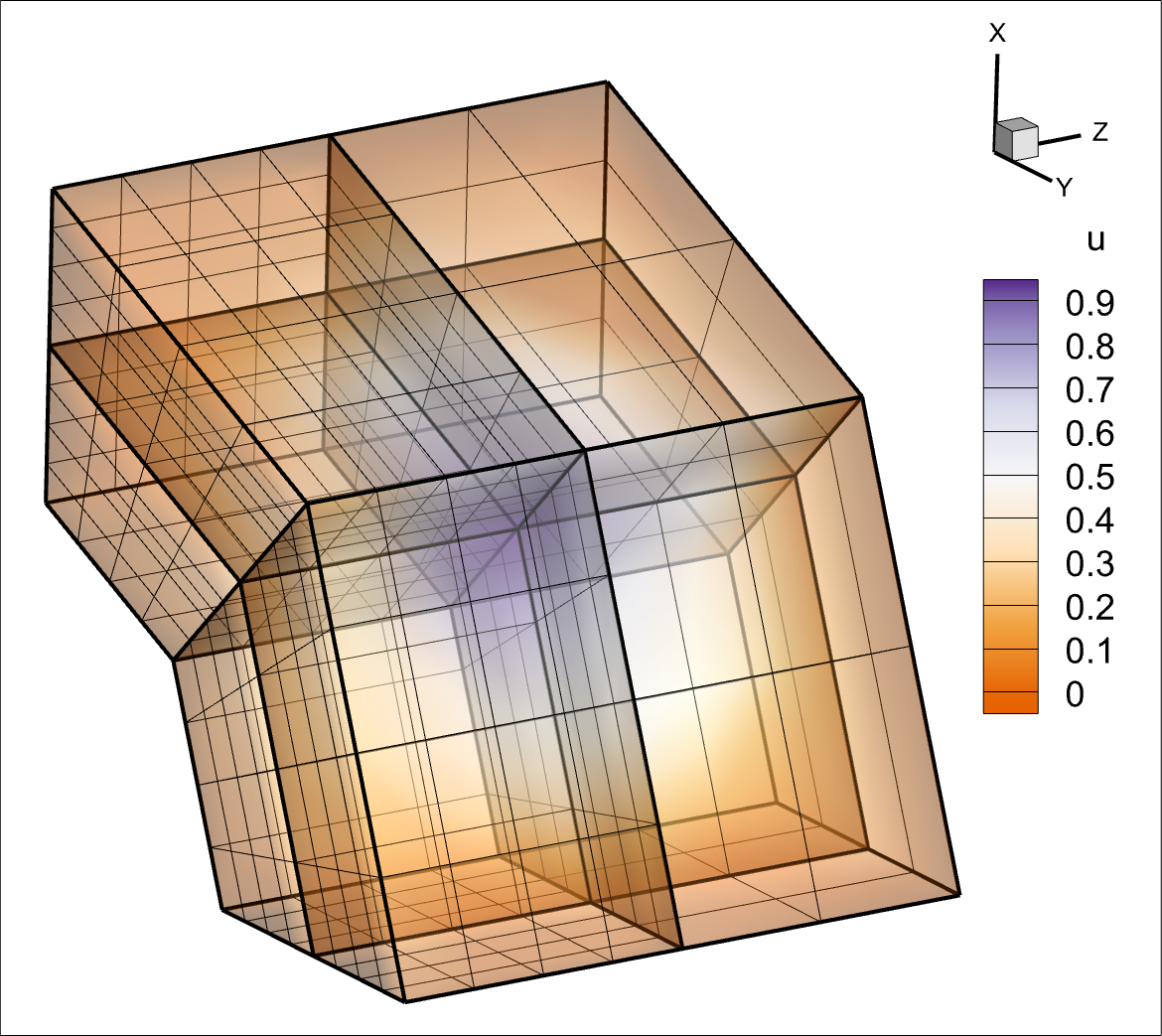
arXiv preprint 2504.03573
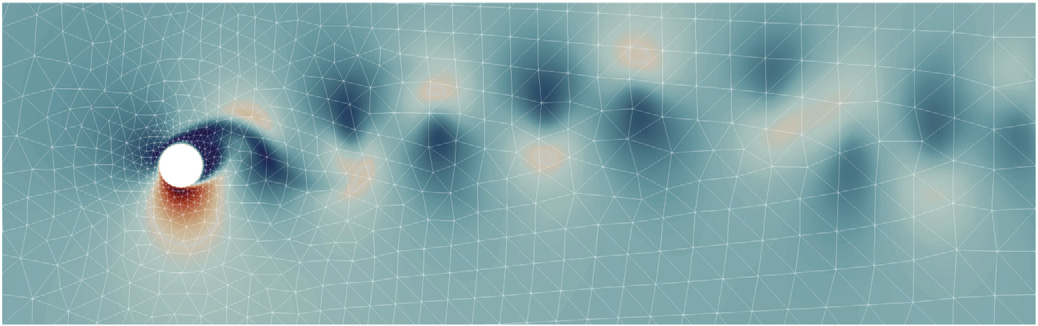
Published version, CC BY, fig. 15
Funded by
-
RAEng Research Chair
A five-year chair developing the next generation of solvers for nuclear fusion modelling, following on from the NEPTUNE projects.
Read more -
APinTA
Parallel-in-time methods for exascale computing.
-
Designing, analysing and implementing numerical methods and deploying them across industrial, biomedical and environmental applications.
Who works on this
All of the team
Prof. David Moxey
Group leader and project leader of the Nektar++ framework.
Previously

Dr. Jacques Xing
Parallel-in-time methods for high-order methods.
Now: Research Software Engineer, Department of Aeronautics, Imperial College London

Dr. Edward Laughton
Developing high-fidelity parallel CFD for problems involving moving geometries.
Now: Trainee Patent Attorney, J A Kemp
Recent papers
All publications-
Unified interface flux evaluation in a general discontinuous Galerkin spectral element framework
SIAM J. Sci. Comput., vol. 48
High-order discontinuous Galerkin spectral element methods (DGSEM) have received growing attention and development, especially in the regime of computational fluid dynamics in recent years. The inherent flexibility of the discontinuous Galerkin approach in handling non-conforming interfaces, such as those encountered in moving geometries or hp-refinement, presents a significant advantage for real-world simulations. Despite the well-established mathematical framework of DG methods, practical implementation challenges persist to boost performance and capability. Most previous studies only focus on certain choices of element shape or basis type in a structured mesh, although they have demonstrated the capability of DGSEM in complex flow simulations. This work discusses the low-cost and unified interface flux evaluation approaches for general spectral elements in unstructured meshes, alongside their implementations in the open-source spectral element framework, Nektar++. The initial motivation arises from the discretization of Helmholtz equations by the symmetric interior penalty method, in which the system matrix can easily become non-symmetric if the flux is not properly evaluated on non-conforming interfaces. We focus on the polynomial non-conforming case in this work but extending to the geometric non-conforming case is theoretically possible. Comparisons of different approaches, trade-offs, and performance of benchmark of our initial matrix-free implementation are also included, contributing to the broader discourse on high-performance spectral element method implementations.@article{xia-2026, title = {Unified interface flux evaluation in a general discontinuous Galerkin spectral element framework}, author = {Xia, B. and Moxey, D.}, journal = {SIAM J. Sci. Comput.}, year = {2026}, doi = {10.1137/25M174824X}, volume = {48}, number = {3}, url = {https://doi.org/10.1137/25M174824X} } -
J. Comput. Phys., vol. 524, pp. 113734
The high-fidelity modelling of geometry which rotates or translates is a key requirement in fluid mechanics applications, enabling the simulation of parts such as rotors and pressure cascades. These prescribed motions can be imposed through movement of the mesh representing the problem, where an interface is constructed across the non-conformal interface bridging the static and moving regions of the mesh, and the challenge is in maintaining solution accuracy of the numerical method across this interface. In this work, we consider the application of a point-to-point interpolation technique leveraging the high-order discontinuous Galerkin method, which has the advantage of being capable of handling complex interfaces that might not be possible under other interpolation techniques. We consider the use of this method within linear and non-linear hyperbolic systems, including the compressible Euler and Navier-Stokes equations, including a detailed analysis of observed error for canonical problems such as flow past a rotating cylinder.@article{lahooti-2025, title = {Discontinuous Galerkin simulation of sliding geometries using a point-to-point interpolation technique}, author = {Lahooti, M. and Laughton, E. and Ye, J. and Cantwell, C. D. and Moxey, D.}, journal = {J. Comput. Phys.}, volume = {524}, pages = {113734}, year = {2025}, doi = {10.1016/j.jcp.2025.113734}, url = {https://www.sciencedirect.com/science/article/pii/S0021999125000178} } -
Enhancing the Nektar++ spectral/hp element framework for parallel-in-time simulations
Comput. Phys. Commun., vol. 312, pp. 109584
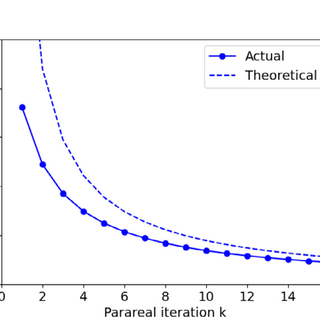
Nektar++ is an open-source spectral/hp element framework designed to support the development of solvers for partial differential equations (PDEs). The software supports various discretization techniques, notably continuous, discontinuous, and hybridizable discontinuous Galerkin projections, in combination with both modal and nodal expansions. The framework uses object-oriented programming paradigms and modern C++ to encapsulate the complexity of the discretization techniques and contains several pre-implemented solvers, while new solvers can be easily implemented in customized proxy-apps. Nektar++ has been designed for high-scalability on high-performance computing (HPC) clusters using distributed memory architecture using a message passing interface (MPI). Recently, time-parallel integration techniques are being recognized as a potential solution to further increase concurrency and computational speed-up beyond the limits of strong scaling obtained from a pure spatial domain decomposition. Amongst the various time-parallel approaches proposed in the literature, the Parareal algorithm is a non-intrusive and iterative approach, exploiting a fine and a coarse solvers to achieve time-parallelism, and can be applied to both linear and non-linear problems. The efficient implementation of the Parareal algorithm in the Nektar++ open-source framework is described in this work, including a discussion of specific techniques used to adapt the code to a time-parallel framework. We demonstrate the application of these methods to multiple linear and non-linear problems provided by the existing Nektar++ solvers.@article{xing-2025, title = {Enhancing the Nektar++ spectral/hp element framework for parallel-in-time simulations}, author = {Xing, J. and Cantwell, C. D. and Moxey, D.}, journal = {Comput. Phys. Commun.}, year = {2025}, volume = {312}, doi = {10.1016/j.cpc.2025.109584}, pages = {109584}, url = {https://www.sciencedirect.com/science/article/pii/S0010465525000876} } -
Fast barycentric-based evaluation over spectral/hp elements
J. Sci. Comp., vol. 90, pp. 78
As the use of spectral/hp element methods, and high-order finite element methods in general, continues to spread, community efforts to create efficient, optimized algorithms associated with fundamental high-order operations have grown. Core tasks such as solution expansion evaluation at quadrature points, stiffness and mass matrix generation, and matrix assembly have received tremendous attention. With the expansion of the types of problems to which high-order methods are applied, and correspondingly the growth in types of numerical tasks accomplished through high-order methods, the number and types of these core operations broaden. This work focuses on solution expansion evaluation at arbitrary points within an element. This operation is core to many postprocessing applications such as evaluation of streamlines and pathlines, as well as to field projection techniques such as mortaring. We expand barycentric interpolation techniques developed on an interval to 2D (triangles and quadrilaterals) and 3D (tetrahedra, prisms, pyramids, and hexahedra) spectral/hp element methods. We provide efficient algorithms for their implementations, and demonstrate their effectiveness using the spectral/hp element library Nektar++.@article{laughton-2022, title = {Fast barycentric-based evaluation over spectral/$hp$ elements}, author = {Laughton, E. and Zala, V. and Narayan, A. and Kirby, R. M. and Moxey, D.}, journal = {J. Sci. Comp.}, year = {2022}, volume = {90}, pages = {78}, url = {https://link.springer.com/content/pdf/10.1007/s10915-021-01750-2.pdf}, doi = {10.1007/s10915-021-01750-2} } -
Comput. Math. Appl., vol. 81, pp. 351–372
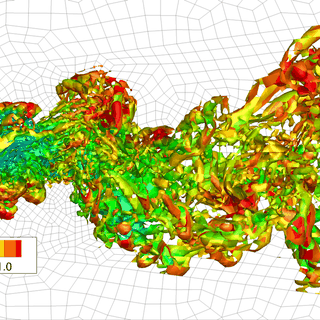
At high Reynolds numbers the use of explicit in time compressible flow simulations with spectral/hp element discretisation can become significantly limited by time step. To alleviate this limitation we extend the capability of the spectral/hp element open-source software framework, Nektar++, to include an implicit discontinuous Galerkin compressible flow solver. The integration in time is carried out by a singly diagonally implicit Runge-Kutta method. The non-linear system arising from the implicit time integration is iteratively solved by the Jacobian-free Newton Krylov (JFNK) method. A favourable feature of the JFNK approach is its extensive use of the explicit operators available from the previous explicit in time implementation. The functionalities of different building blocks of the implicit solver are analyzed from the point view of software design and placed in appropriate hierarchical levels in the C++ libraries. In the detailed implementation, the contributions of different parts of the solver to computational cost, memory consumption and programming complexity are also analyzed. A combination of analytical and numerical methods is adopted to simplify the programming complexity in forming the preconditioning matrix. The solver is verified and tested using cases such as manufactured compressible Poiseuille flow, Taylor-Green vortex, turbulent flow over a circular cylinder at Re = 3900 and shock wave boundary-layer interaction. The results show that the implicit solver can speed-up the simulations while maintaining good simulation accuracy.@article{yan-2020, title = {\emph{Nektar++}: Design and implementation of an implicit spectral/hp element compressible flow solver using a Jacobian-free Newton Krylov approach}, author = {Yan, Z. and Pan, Y. and Castiglioni, G. and Hillewaert, K. and Peir\'o, J. and Moxey, D. and Sherwin, S. J.}, year = {2021}, journal = {Comput. Math. Appl.}, volume = {81}, pages = {351--372}, url = {https://arxiv.org/abs/2002.04222}, doi = {10.1016/j.camwa.2020.03.009} }
Collaborators
- Spencer Sherwin Imperial College London
- Joaquim Peiró Imperial College London
- Chris Cantwell Imperial College London
- Mike Kirby University of Utah
- Gianmarco Mengaldo National University of Singapore
Interested in working on this?
We are always glad to hear from prospective PhD students and postdocs, and from groups who would like to work with us. Our openings page lists what is currently funded and the routes that are open year round.
Join us