How we compute
Mesh generation and adaptation
Before any simulation can run, the shape being simulated has to be broken into simpler elements. For high-order methods those elements have to curve to follow the surface, and generating them reliably is one of the largest practical obstacles to using these methods in practice.
A mesh is the scaffolding a simulation is built on. For the low-order methods used in most industrial software, generating a mesh is perhaps seen as a solved problem; however there are many open challenges, from designing robust methods that handle unclean geometry, to accurately resolving the surface and putting resolution where it is required for the physics of the desired solver.
For high-order methods this complexity increases substantially: the elements must curve to follow the geometry, and a curved element can fold in on itself in ways a straight one cannot. A single invalid element anywhere in a mesh of millions stops the simulation.
We work on generating those meshes automatically, and on keeping them valid once generated. Our approach treats the mesh as a deformable solid: starting from a straight-sided mesh, the boundary is pushed onto the true geometry and the interior deforms to accommodate it, with the elastic model chosen so that elements resist inverting. That idea began as a thermo-elastic analogy and has since become a general variational framework, in which mesh quality, validity and boundary conformity are all terms in one energy that is minimised.
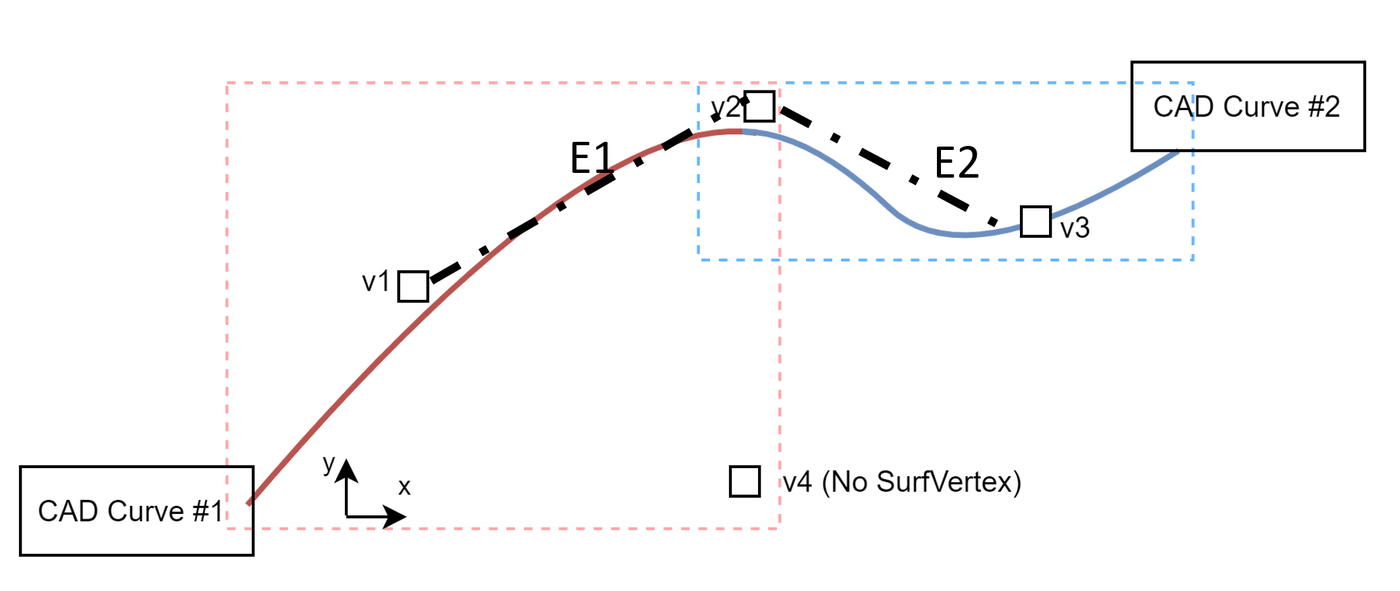
Two problems follow on from it, and both are active research areas. The first is geometry: a mesh is only as good as the CAD description it is curved onto, and in practice that description is often missing, inconsistent, or was never watertight to begin with. We develop techniques that can leverage a combination of tools to overcome this challenge. The second is adaptation, or changing the mesh as the solution develops, so that resolution goes where the physics needs it rather than where it was guessed at the start.
Our work here is implemented in the open-source mesh generator NekMesh, which is open source and used well beyond the group.
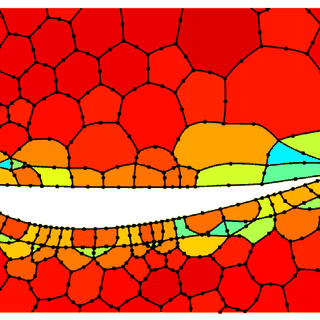
Accepted version, fig. 7
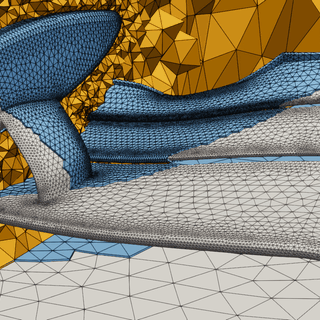
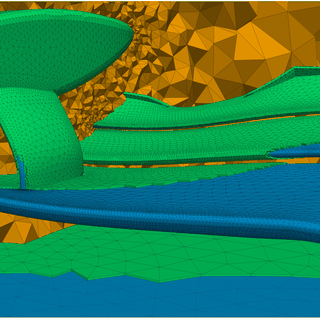
Published version, CC BY, fig. 26(b)
Funded by
-
A 60-month programme led by Swansea University, with Imperial College London, Queen’s University Belfast and EPCC. Our contribution builds on Nektar++ and NekMesh.
Read more -
NekMesh for industry
A one-year award to improve the usability and robustness of high-order mesh generation in NekMesh.
-
Addressing mesh generation and adaptation as a high-priority exascale use case under phase 1 of ExCALIBUR.
Read more
Who works on this
All of the team
Prof. David Moxey
Group leader and project leader of the Nektar++ framework.

Dr. Kaloyan Kirilov
High-order mesh generation and the representation of CAD geometry.

Dr. Arthur Bawin
Mesh generation and adaptation, as part of the REMODEL programme grant.

Previously
Dr. Mashy Green
Mesh generation and solvers for nuclear fusion applications.
Now: Senior Research Software Engineer, Advanced Research Computing, UCL
Recent papers
All publications-
High-order curvilinear mesh generation from third-party meshes
Comput. Aided Design, vol. 191, pp. 103962
Established \em a posteriori mesh generation, high-order mesh curving and some mesh optimization approaches often rely on an accurate CAD parametrization of the boundary of the computational domain. This information, however, is not always available, especially when composite multi-software workflows are employed. To deal with such cases, we propose a method for reconstructing the missing connectivity information between the mesh and the CAD geometry when importing an arbitrarily sourced mesh. The reconstruction is followed by curving methods for order elevation, projections or subsequently optimisations with boundary-conforming node sliding. Lastly, mesh modification techniques are used to achieve the desired mesh resolution and quality for meshes incorporating boundary layers. We illustrate the steps of the proposed end-to-end workflow through two simple geometries coming from different sources and an end-to-end complex automotive mesh generation test case.@article{kirilov-2025a, title = {High-order curvilinear mesh generation from third-party meshes}, author = {Kirilov, K. S. and Zhou, J. and Peir\'o, J. and Moxey, D.}, year = {2026}, pages = {103962}, volume = {191}, journal = {Comput. Aided Design}, doi = {10.1016/j.cad.2025.103962}, url = {https://davidmoxey.uk/assets/pubs/2026-third-party-meshes.pdf} } -
Mesh generation of curvilinear polygons for the high-order virtual element method (VEM)
Comput. Aided Design, vol. 190, pp. 103966
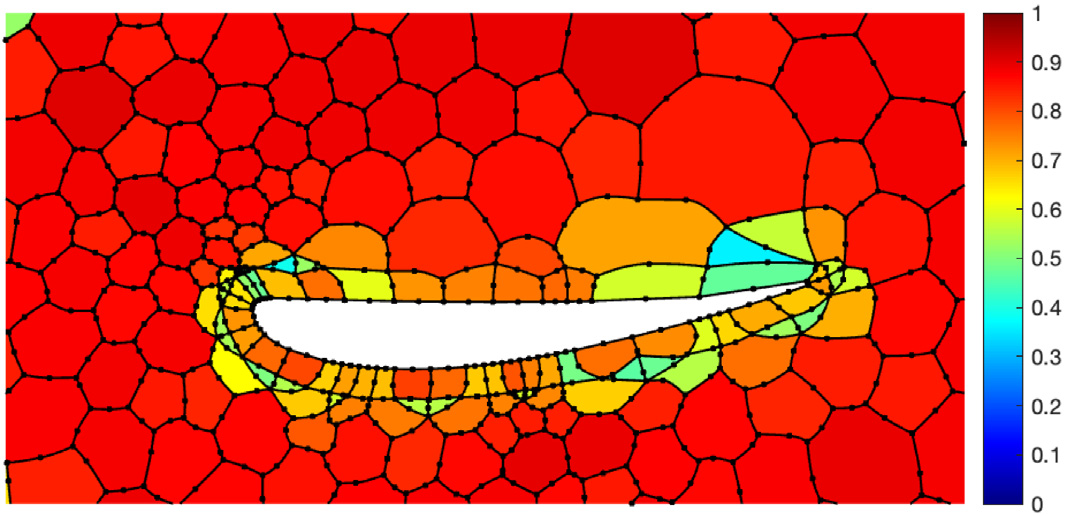
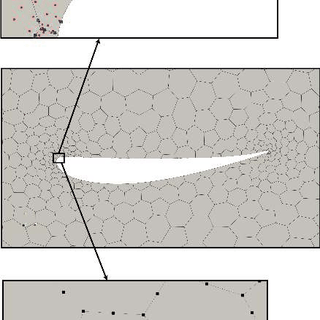
We present a proof-of-concept methodology for generating curvilinear polygonal meshes suitable for high-order discretisations by the Virtual Element Method (VEM). A VEM discretisation requires the definition of a set of boundary and internal points used to define basis functions and compute integrals of polynomials. The procedure to locate these points on the boundary borrows ideas from previous work on a posteriori high-order mesh generation in which the geometrical inquiries to a B-rep model of the computational domain are performed via an interface to CAD libraries. Here we describe the steps of the procedure that transforms a straight-sided polygonal mesh, generated using third-party software, into a curvilinear boundary-conforming mesh. We discuss criteria for ensuring and verifying the validity of the mesh. Using an elliptic partial differential equation with Dirichlet boundary conditions as a model problem, we show that VEM discretisations on such meshes achieve the expected rates of convergence as the mesh resolution is increased. This is followed by an illustrative application of the method to the generation of a curvilinear polygonal mesh for an aerofoil geometry. We discuss polygonal curvilinear mesh quality and its enhancement, and use the motion of a cell vertex to appraise three elemental quality metrics, namely convexity, regularity and isotropy, and highlight some of the difficulties associated in their use for mesh quality optimisation. A derivative-free optimisation method is utilised to enhance curvilinear polygonal meshes by maximising a suitable measure of mesh quality. We propose such measure as a combination of the three quality metrics and apply it to optimise a distorted initial mesh for a ring geometry. We show that a suitable version of the convexity metric is effective in untangling invalid meshes. The VEM solution of a model elliptic equation is obtained for a ring geometry where a distorted and an optimised mesh show low errors, indicating that the VEM is robust and relatively insensitive to mesh distortion, and a reduction of the error in the optimised mesh. Finally, we use a more complex geometry, a computational domain for an aerofoil, as a benchmark to further illustrate the ability of the convexity metric to untangle meshes, and also to assess the suitability of two quality measures as optimisation targets to improve the overall quality of curvilinear polygonal meshes.@article{kirilov-2025b, title = {Mesh generation of curvilinear polygons for the high-order virtual element method (VEM)}, author = {Kirilov, K. S. and Zhou, J. and Peir\'o, J. and Green, M. and Moxey, D. and da Veiga, L. Beirão and Russo, A. and Dassi, F.}, url = {https://www.sciencedirect.com/science/article/pii/S0010448525001277}, doi = {10.1016/j.cad.2025.103966}, journal = {Comput. Aided Design}, pages = {103966}, volume = {190}, year = {2026} } -
High-order curvilinear mesh generation from third-party meshes
International Conference on Spectral and High-Order Methods
Established a posteriori mesh curving techniques often rely on an accurate CAD parametrisation of the underlying mesh objects which may not always be available. To deal with such cases, we propose a method for reconstructing the missing information between the mesh and the CAD geometry when importing an arbitrarily sourced straight- sided mesh. The reconstruction is followed by curving methods for order elevation, projections and, subsequently, optimisation. Lastly, mesh modification techniques are used to achieve the desired mesh resolution and quality. We illustrate the steps of the proposed workflow through a simple geometry and a complex automotive geometry.@inproceedings{kirilov-2024, title = {High-order curvilinear mesh generation from third-party meshes}, author = {Kirilov, K. and Peir\'o, J. and Zhou, J. and Green, M. D. and Moxey, D.}, booktitle = {International Conference on Spectral and High-Order Methods}, doi = {10.1137/1.9781611978001}, url = {https://internationalmeshingroundtable.com/assets/papers/2024/1018.pdf}, year = {2024} } -
NekMesh: An open-source high-order mesh generation framework
Comput. Phys. Commun., pp. 109089
High-order spectral element simulations are now becoming increasingly popular within the computational modelling community, as they offer the potential to deliver increased accuracy at reduced cost compared to traditional low-order codes. However, to support accurate, high-fidelity simulations in complex industrial applications, there is a need to generate curvilinear meshes which robustly and accurately conform to geometrical features. This is, at present, a key challenge within the mesh generation community, with only a few open-source tools able to generate curvilinear meshes for complex geometries. We present NekMesh: an open-source mesh generation package which is designed to enable the generation of valid, high-quality curvilinear meshes of complex, three-dimensional geometries for performing high-order simulations. We outline the software architecture adopted in NekMesh, which uses a pipeline of processing modules to provide a flexible, CAD-independent high-order mesh processing tool, capable of both generating meshes for a wide range of use cases, as well as post-processing linear meshes from a range of input formats for use with high-order simulations. A number of examples in various application areas are presented, with a particular emphasis on challenging aeronautical and fluid dynamics test cases.@article{green-2024, title = {NekMesh: An open-source high-order mesh generation framework}, author = {Green, M. D. and Kirilov, K. S. and Turner, M. and Marcon, J. and Eichst\"adt, J. and Laughton, E. and Cantwell, C. D. and Sherwin, S. J. and Peir\'o, J. and Moxey, D.}, journal = {Comput. Phys. Commun.}, year = {2024}, number = {298}, pages = {109089}, doi = {10.1016/j.cpc.2024.109089}, url = {https://www.sciencedirect.com/science/article/pii/S0010465524000122} } -
Curvilinear mesh generation for the high-order virtual element method (VEM)
SIAM International Meshing Roundtable Workshop
We present a proof-of-concept methodology for generating curvilinear polygonal meshes suitable for high-order discretizations by the Virtual Element Method (VEM). A VEM discretization requires the definition of a set of boundary and internal points that are used to interpolate the approximation functions and to evaluate integrals by means of suitable quadratures. The procedure to locate these points on the boundary borrows ideas from previous work on a posteriori high-order mesh generation in which the geometrical inquiries to a B-rep of the computational domain are performed via an interface to CAD libraries. Here we describe the steps of the procedure that transforms a straight-sided polygonal mesh, generated using third-party software, into a curvilinear boundary-conforming mesh. We discuss criteria for ensuring and verifying the validity of the mesh. Finally, using the Laplace equation with Dirichlet boundary conditions as a model problem, we show that VEM discretizations on such meshes achieve the expected rates of convergence as the mesh resolution is increased.@inproceedings{kirilov-2023, title = {Curvilinear mesh generation for the high-order virtual element method (VEM)}, author = {Kirilov, K. and Peir\'{o}, J. and Green, M. and Moxey, D. and da Veiga, L. Beirao and Dassi, F. and Russo, A.}, booktitle = {SIAM International Meshing Roundtable Workshop}, year = {2023}, url = {https://internationalmeshingroundtable.com/assets/papers/2023/21-Kirilov-compressed.pdf} }
Collaborators
- Joaquim Peiró Imperial College London
- Franco Dassi University of Milano-Bicocca
Interested in working on this?
We are always glad to hear from prospective PhD students and postdocs, and from groups who would like to work with us. Our openings page lists what is currently funded and the routes that are open year round.
Join us