What we compute
Transition and turbulence
Fluids move in two basic ways: smoothly, or chaotically. How they get from one to the other is a century-old question that is still open, and it is the physics underneath most of what else we do, in ordinary fluids and in the plasma inside a fusion reactor alike.
Water flowing slowly through a pipe is smooth and predictable, but push it faster and the motion becomes turbulent: irregular, three-dimensional and mixing violently. The two states are individually well-studied: what is far less understood is the transition between them, where the flow is neither one thing nor the other but a patchwork of both, with turbulent regions that can grow, split, or die out at random.
Our work on this began with pipe flow, the canonical case of transition, using simulations of pipes long enough to see the large-scale structure rather than a single patch of it. The behaviour turns out to have the character of a phase transition, which connects a practical engineering question to statistical physics.
Why it matters beyond this fundamental problem is that transitional regions behave differently from either laminar or fully turbulent ones, and a simulation that assumes the wrong state gets the drag wrong. Aircraft, turbine blades and vehicles all operate in conditions where transition is what determines the answer.
The same questions recur in a setting we did not originally expect but is now one of the central problems of our work in fusion. In the edge of a tokamak the plasma is turbulent, strongly anisotropic, and transports heat along magnetic field lines far faster than across them. Predicting where that heat lands is a central problem in reactor design, and it is turbulence modelling with different physics attached.
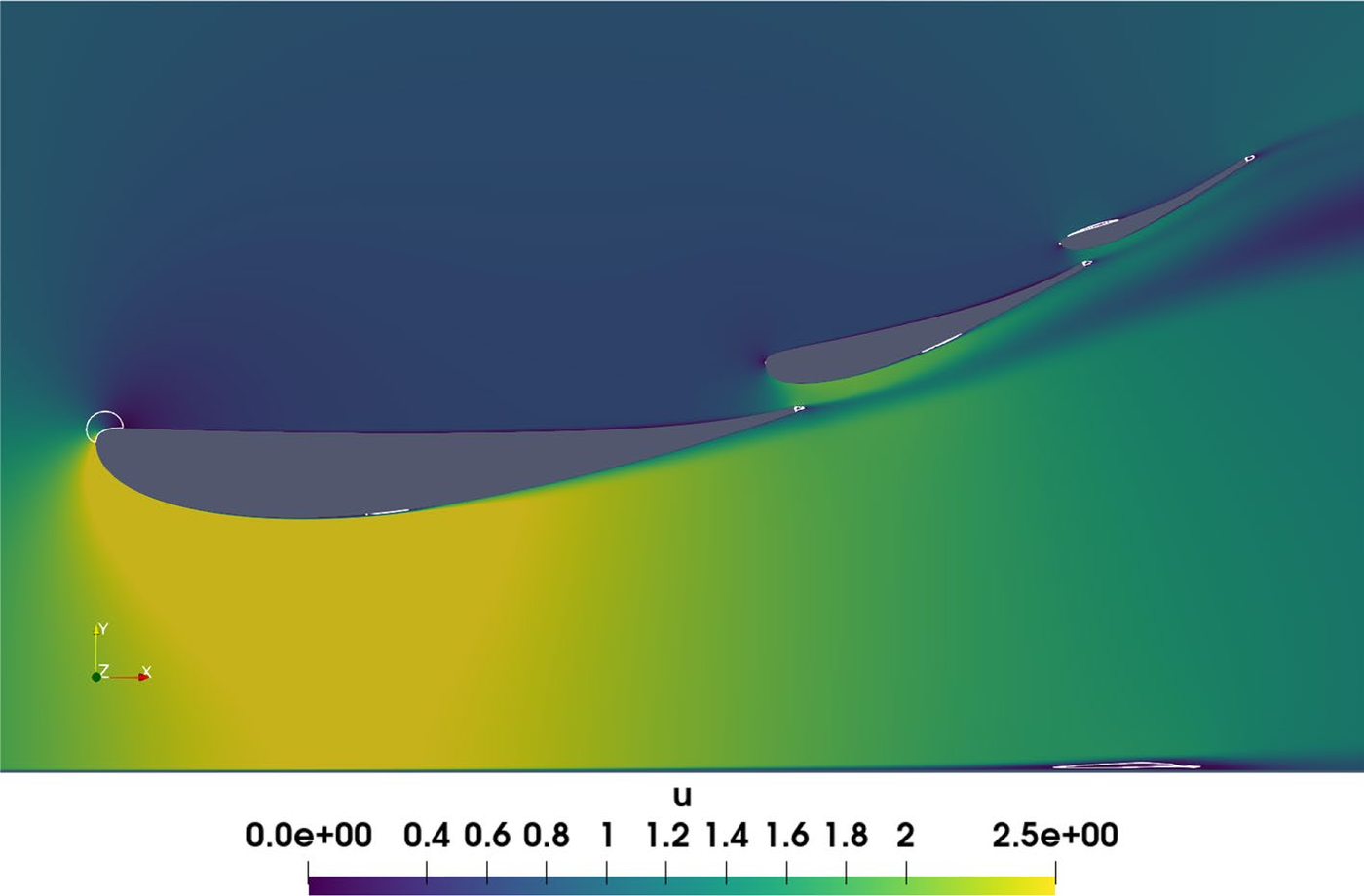
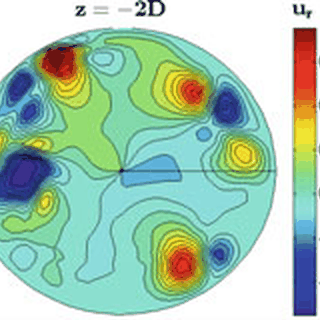
Published version, CC BY, fig. 9
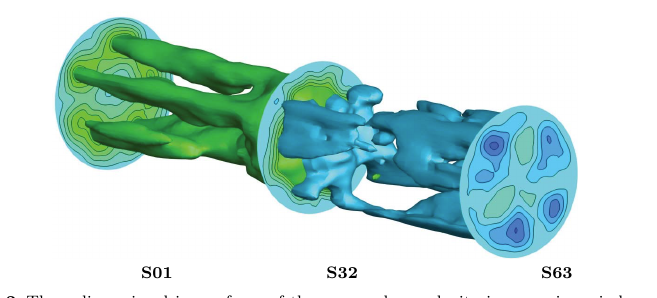
Author-hosted PDF, fig. 2
Who works on this
All of the team
Prof. David Moxey
Group leader and project leader of the Nektar++ framework.
Recent papers
All publications-
Large eddy simulation of an inverted multi-element wing in ground effect
Flow Turbul. Combust., pp. 917-944
Due to the proprietary nature of modern motorsport and Formula 1, current scientific literature lacks relevant studies and benchmarks that can be used to test and validate new methods. Due to the release of a free geometry - the Imperial Front Wing - we present a computational study of a multi-element aerofoil at a ride height of 0.36h/c and a Reynolds Number of 2.2 × 10⁵. A 0.16c slice of the Imperial has been examined using high-order Spectral/hp Element Methods. Time averaged force data is presented finding lift and drag coefficients of -8.33 and 0.17 respectively. Transient analysis of the force- and surface pressure data resulted in salient mode identification with respect to the transition mechanisms of each element.The mainplane and flap laminar separation were studied and the cross-spectral phase presented for the lower frequency modes. At a St=40 an in-phase relationship was identified between mainplane and flap Laminar Separation Bubbles, whilst at St=60 a distinct out-of-phase relationship was identified. Wake results including wake-momentum deficit and turbulent kinetic energy plots have been presented - showing wake meandering and subsequent break down due to a Kelvin-Helmholtz instability. These results, particularly the transition mechanisms will allow for the construction of a data set to validate novel methods in this area.@article{slaughter-2023, title = {Large eddy simulation of an inverted multi-element wing in ground effect}, author = {Slaughter, J. and Moxey, D. and Sherwin, S. J.}, journal = {Flow Turbul. Combust.}, year = {2023}, number = {110}, pages = {917-944}, doi = {10.1007/s10494-023-00404-7}, url = {https://link.springer.com/content/pdf/10.1007/s10494-023-00404-7.pdf} } -
Turbulence in a localized puff in a pipe
Flow Turbul. Combust., vol. 103, pp. 1–24
We have performed direct numerical simulations of a spatio-temporally intermittent flow in a pipe for Rem = 2250. From previous experiments and simulations of pipe flow, this value has been estimated as a threshold when the average speeds of upstream and downstream fronts of a puff are identical. We investigated the structure of an individual puff by considering three-dimensional snapshots over a long time period. To assimilate the velocity data, we applied a conditional sampling based on the location of the maximum en- ergy of the transverse (turbulent) motion. Specifically, at each time instance, we followed a turbulent puff by a three-dimensional moving window centered at that location. We collected a snapshot-ensemble (10000 time instances, snap- shots) of the velocity fields acquired over T = 2000D/U time interval inside the moving window. The cross-plane velocity field inside the puff showed the dynamics of a developing turbulence. In particular, the analysis of the cross- plane radial motion yielded the illustration of the production of turbulent kinetic energy directly from the mean flow. A snapshot-ensemble averaging over 10000 snapshots revealed azimuthally arranged large-scale (coherent) structures indicating near-wall sweep and ejection activity. The localized puff is about 15-17 pipe diameters long and the flow regime upstream of its upstream edge and downstream of its leading edge is almost laminar. In the near-wall region, despite the low Reynolds number, the turbulence statistics, in particular, the distribution of turbulence intensities, Reynolds shear stress, skewness and flatness factors, become similar to a fully-developed turbulent pipe flow in the vicinity of the puff upstream edge. In the puff core, the velocity profile becomes flat and logarithmic. It is shown that this “fully-developed turbulent flash” is very narrow being about two pipe diameters long.@article{yakhot-2019, title = {Turbulence in a localized puff in a pipe}, author = {Yakhot, A. and Feldman, Y. and Moxey, D. and Sherwin, S. J. and Karniadakis, G. E.}, journal = {Flow Turbul. Combust.}, volume = {103}, number = {1}, pages = {1--24}, year = {2019}, url = {https://davidmoxey.uk/assets/pubs/2018-puff-turb.pdf}, doi = {10.1007/s10494-018-0002-8} } -
Near-Wall Turbulence in a Localized Puff in a Pipe
Progress in Turbulence VIII, pp. 15–20
We have performed direct numerical simulations of a transitional flow in ai pipe for Rem=2250 when turbulence manifests in the form of fleshes (puffs). From experiments and simulations, Rem approx 2250 has been estimated as a threshold when the average speeds of upstream and downstream fronts of a puff are identical (Song et al. in J Fluid Mech 813:283–304, 2017, [1]). The flow regime upstream of its trailing edge and downstream of its leading edge is almost laminar. To collect the velocity data, at each time instance, we followed a turbulent puff by a three-dimensional moving window centered at the location of the maximum energy of the transverse (turbulent) motion. In the near-wall region, despite the low Reynolds number, the turbulence statistics, in particular, the distribution of turbulence intensities and Reynolds shear stress becomes similar to a fully-developed turbulent pipe flow.@inproceedings{yakhot-2019b, author = {Yakhot, A. and Feldman, Y. and Moxey, D. and Sherwin, S. J. and Karniadakis, G. E.}, editor = {{\"O}rl{\"u}, Ramis and Talamelli, Alessandro and Peinke, Joachim and Oberlack, Martin}, title = {Near-Wall Turbulence in a Localized Puff in a Pipe}, booktitle = {Progress in Turbulence VIII}, year = {2019}, publisher = {Springer}, pages = {15--20}, isbn = {978-3-030-22196-6}, doi = {10.1007/978-3-030-22196-6_3}, url = {https://davidmoxey.uk/assets/pubs/2019-nearwall-turb.pdf} } -
Phys. Rev. Fluids, vol. 3, pp. 024101
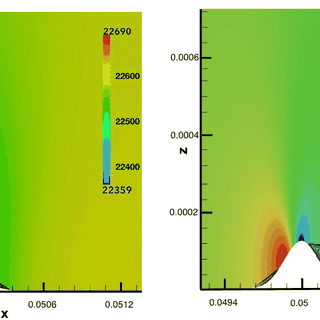
In this paper we study the boundary-layer separation produced in a high-speed subsonic boundary layer by a small wall roughness. Specifically, we present a direct numerical simulation (DNS) of a two-dimensional boundary-layer flow over a flat plate encountering a three-dimensional Gaussian-shaped hump. This work was motivated by the lack of DNS data of boundary-layer flows past roughness elements in a similar regime which is typical of civil aviation. The Mach and Reynolds numbers are chosen to be relevant for aeronautical applications when considering small imperfections at the leading edge of wings. We analyze different heights of the hump: The smaller heights result in a weakly nonlinear regime, while the larger result in a fully nonlinear regime with an increasing laminar separation bubble arising downstream of the roughness element and the formation of a pair of streamwise counterrotating vortices which appear to support themselves.@article{degrazia-2016, title = {DNS of a compressible boundary layer flow past an isolated three-dimensional hump in a high-speed subsonic regime}, author = {de Grazia, D. and Moxey, D. and Sherwin, S. J. and Kravtsova, M. A. and Ruban, A. I.}, journal = {Phys. Rev. Fluids}, volume = {3}, pages = {024101}, year = {2018}, doi = {10.1103/PhysRevFluids.3.024101}, url = {https://davidmoxey.uk/assets/pubs/2018-prf.pdf} } -
Implicit large-eddy simulation of a wingtip vortex
AIAA J., vol. 54, pp. 506–518
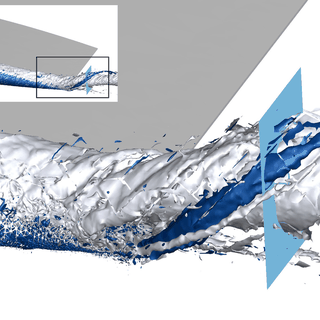
In this article, recent developments in numerical methods for performing a large-eddy simulation of the formation and evolution of a wingtip vortex are presented. The development of these vortices in the near wake, in combination with the large Reynolds numbers present in these cases, makes these types of test cases particularly challenging to investigate numerically. First, an overview is given of the spectral vanishing viscosity/implicit large-eddy simulation solver that is used to perform the simulations, and techniques are highlighted that have been adopted to solve various numerical issues that arise when studying such cases. To demonstrate the method’s viability, results are presented from numerical simulations of flow over a NACA 0012 profile wingtip at Rec=1.2· 106 and they are compared against experimental data, which is to date the highest Reynolds number achieved for a large-eddy simulation that has been correlated with experiments for this test case. The model in this paper correlates favorably with experiment, both for the characteristic jetting in the primary vortex and pressure distribution on the wing surface. The proposed method is of general interest for the modeling of transitioning vortex-dominated flows over complex geometries.@article{lombard-2016, title = {Implicit large-eddy simulation of a wingtip vortex}, author = {Lombard, J.-E. W. and Moxey, D. and Sherwin, S. J. and Hoessler, J. F. A. and Dhandapani, S. and Taylor, M. J.}, year = {2016}, journal = {AIAA J.}, volume = {54}, number = {2}, pages = {506--518}, url = {http://arxiv.org/abs/1507.06012}, doi = {10.2514/1.J054181} }
Collaborators
- Spencer Sherwin Imperial College London
- Dwight Barkley University of Warwick
- Alexander Yakhot Ben-Gurion University of the Negev
- Yuri Feldman Ben-Gurion University of the Negev
Interested in working on this?
We are always glad to hear from prospective PhD students and postdocs, and from groups who would like to work with us. Our openings page lists what is currently funded and the routes that are open year round.
Join us