What we compute
Fusion
Building a fusion power plant means predicting what happens to a plasma hotter than the centre of the Sun, held in place by magnetic fields, in a machine that does not exist yet. We build the simulation methods and software that this design work will depend on.
The world’s first commercial nuclear fusion reactor will secure a long-term, sustainable and net-zero source of energy for future generations. Fusion is the process that powers the Sun, and reproducing it on Earth would give a source of energy with no carbon emissions and no long-lived radioactive waste. The engineering problem is that the fuel has to be held at over a hundred million degrees while not touching the inside of the reactor, which is done with magnetic fields inside a machine called a tokamak.
Designing such a machine relies heavily on simulation, because the experiments are few, extremely expensive, and cannot be run before the reactor is built. The plasma edge — the region between the hot core and the wall — is particularly demanding: it is where the heat exhaust arrives, so it determines what the wall has to survive, and it is where the physics are least tractable. Transport along the magnetic field can be millions of times faster than across it, which makes the problem severely anisotropic, which is a significant modelling challenge.
The UK Atomic Energy Authority (UKAEA) has been charged with positioning the UK as a leader in fusion, by designing a commercially-viable reactor by the 2040s. To achieve this within this timeframe requires use of computation at a previously unseen scale, to avoid the need for expensive test- based designs. Despite the potential for “in silico” design that could be enabled through the power of the world’s latest exascale supercomputers, there is a gap between the state-in-the-art of fusion modelling software, and the ability to use these supercomputers to their full potential. In part, this is owing to the complexity of fusion: engineers need flexibility to investigate the interactions of many performance-critical parameters such as impurities, and their impact on phenomena such as plasma turbulence, which significantly affect reactor stability.
This is where high-order methods we develop in our group can have a significant impact.Their accuracy per degree of freedom, ability to align elements with a complicated geometry and field direction, and their arithmetic intensity matters because these simulations will run on exascale machines.
Our work here runs through several initiatives: the NEPTUNE programme, part of the UK’s ExCALIBUR effort, and through a Royal Academy of Engineering Research Chair held jointly with the UK Atomic Energy Authority. It draws on everything else the group does: the mesh generation, because reactor geometry is complex and the meshes have to follow the field; the numerical methods, because the anisotropy breaks standard discretisations; and the performance work, because the target machines are the largest that will exist.
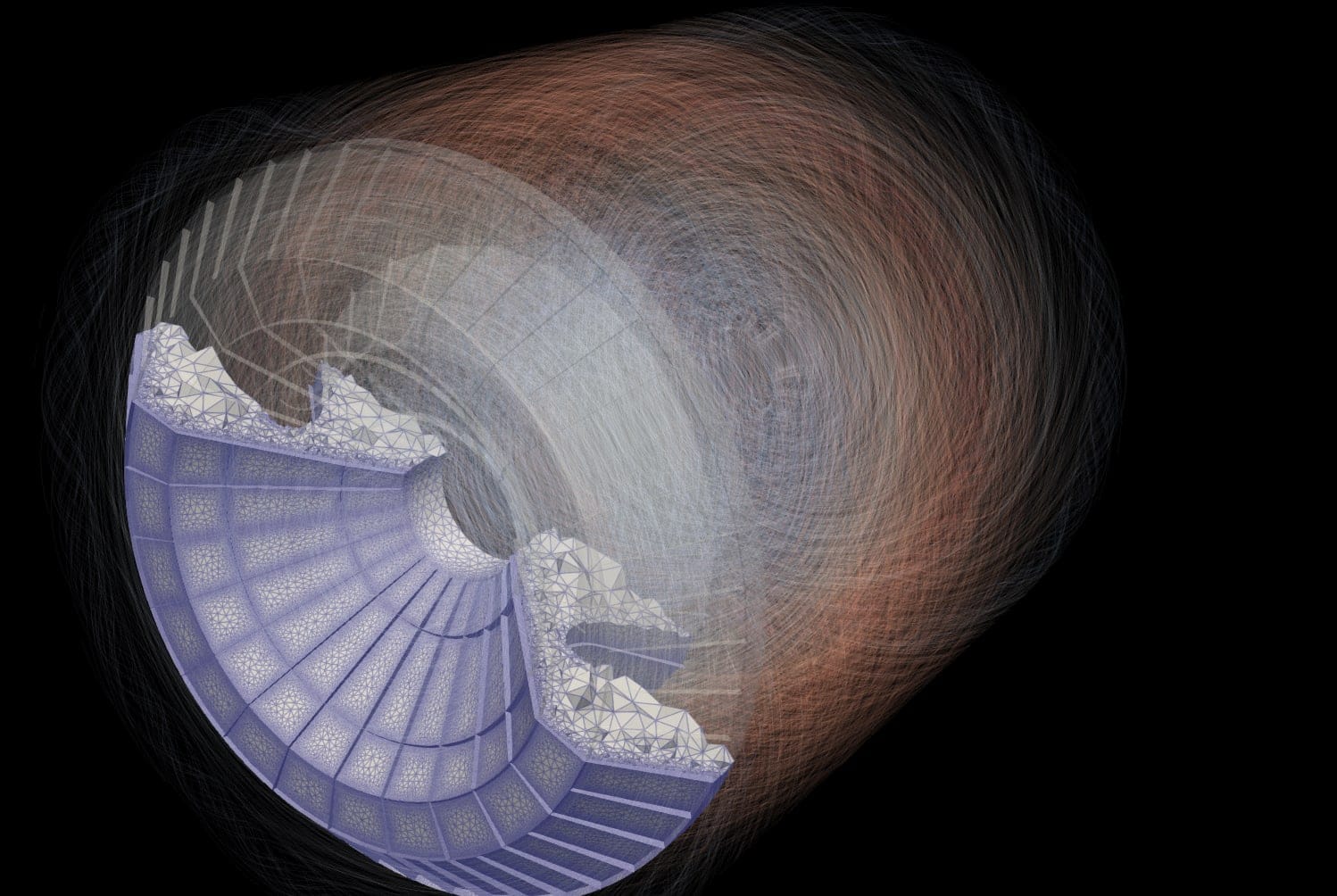
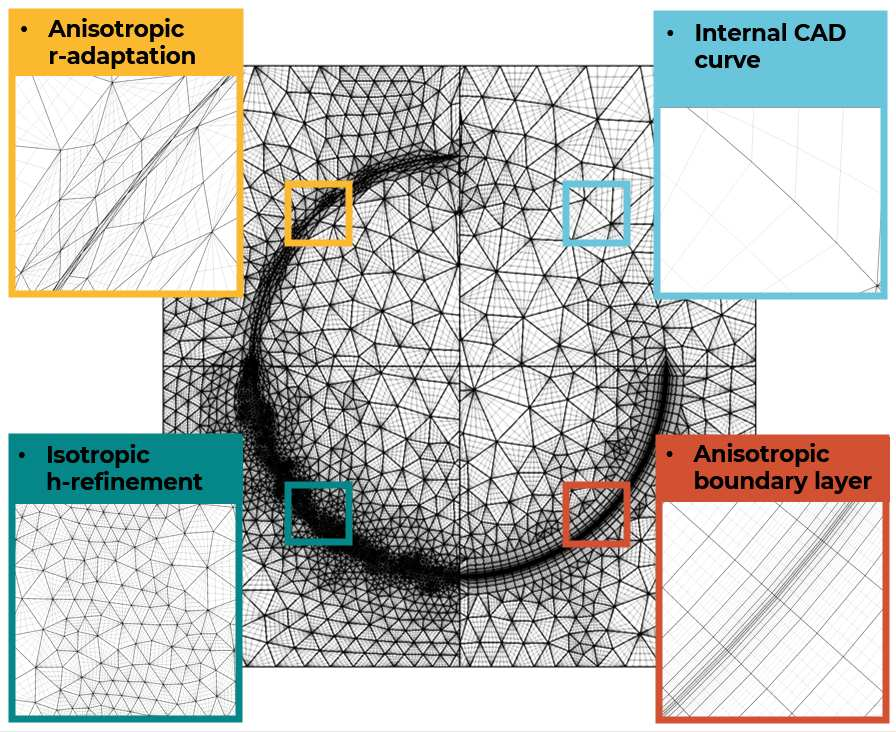
Accepted version, CC BY, fig. 3
Funded by
-
RAEng Research Chair
A five-year chair developing the next generation of solvers for nuclear fusion modelling, following on from the NEPTUNE projects.
Read more -
NEPTUNE (2022)
Developing high-order solvers for nuclear fusion modelling under the strategic priorities fund ExCALIBUR programme.
Who works on this
All of the team
Prof. David Moxey
Group leader and project leader of the Nektar++ framework.

Dr. Kaloyan Kirilov
High-order mesh generation and the representation of CAD geometry.

Previously

Dr. Mashy Green
Mesh generation and solvers for nuclear fusion applications.
Now: Senior Research Software Engineer, Advanced Research Computing, UCL
Recent papers
All publications-
29th IAEA Fusion Energy Conference, proceedings
This article provides a broad overview of Project NEPTUNE, which aims to create code for simulating edge plasma physics at scales approaching the exascale, and is run by the UKAEA as part of the UK’s ExCALIBUR framework. It is a representative survey of scope and associated outputs, rather than a detailed exposition; the structure is such as to describe the core components of NEPTUNE (efforts toward simulation of plasma fluid and kinetic effects, and their synthesis into exascale-ready combined codes) and then give an indication of the wide range of other work performed under the project.@inproceedings{threlfall-2023, title = {Software for Fusion Reactor Design: ExCALIBUR Project NEPTUNE: Towards Exascale Plasma Edge Simulations}, author = {Threlfall, EJ and Akers, RJ and Arter, W and Barnes, M and Barton, M and Cantwell, C and Challenor, P and Cook, JWS and Coveney, PV and Dodwell, T and others}, booktitle = {29th IAEA Fusion Energy Conference, proceedings}, year = {2023}, url = {https://eprints.whiterose.ac.uk/204359/1/IAEA_CN_316_2132.pdf}, organization = {York} } -
8th European Congress on Computational Methods in Applied Sciences and Engineering
@inproceedings{liu-2022,
  author = {Liu, B. and Cantwell, C. D. and Moxey, D. and Green, M. and Sherwin, S. J.},
  title = {Vectorised spectral/hp element matrix-free operator for anisotropic heat transport in tokamak edge plasma},
  booktitle = {8th European Congress on Computational Methods in Applied Sciences and Engineering},
  doi = {10.23967/eccomas.2022.291},
  url = {https://www.scipedia.com/public/Liu_et_al_2022b},
  year = {2022}
}
Collaborators
- Ed Threlfall UK Atomic Energy Authority
- James Edgeley UK Atomic Energy Authority
Interested in working on this?
We are always glad to hear from prospective PhD students and postdocs, and from groups who would like to work with us. Our openings page lists what is currently funded and the routes that are open year round.
Join us