What we compute
Industrial aerodynamics
Methods are worth having only if they answer questions somebody actually has. We apply high-order simulation to real engineering geometries — racing cars, aircraft wings, fans — usually in cases where the standard industrial approach gives an answer that is not accurate enough to design with.
Industrial CFD is dominated by methods that model turbulence rather than resolve it. They are fast, robust and well understood, and for attached flow over simple shapes they are entirely adequate. They become unreliable exactly where the interesting engineering is: separated flow, wakes interacting with downstream components, vortices that have to be tracked a long way without being smeared out by the numerics.
Scale-resolving simulation avoids the modelling assumption by computing the turbulence directly, but has historically been too expensive and too fragile on complex geometry to use in a design cycle. Much of our applied work is about closing that gap, and it takes real cases as the test: a Formula One front wing, whose wake determines the performance of everything behind it and which we have validated against wind-tunnel experiment; a full high-performance road car; an inverted multi-element wing in ground effect; an aircraft wingtip vortex, which sets the spacing between aircraft on approach and so the capacity of an airport.
A second strand is turbomachinery, through a knowledge transfer partnership with a fan manufacturer. Here the questions are different: not what happens in one carefully chosen configuration, but how to search a design space efficiently, and how to trade aerodynamic performance against the noise a fan emits. That work combines simulation with surrogate models and optimisation, because the simulations are too expensive to put directly inside an optimiser.
Working this way keeps the methods honest. Complex geometry is what breaks mesh generators, industrial timescales are what expose a solver that is only fast in principle, and a partner with a product to ship asks questions that a purely academic test case does not.
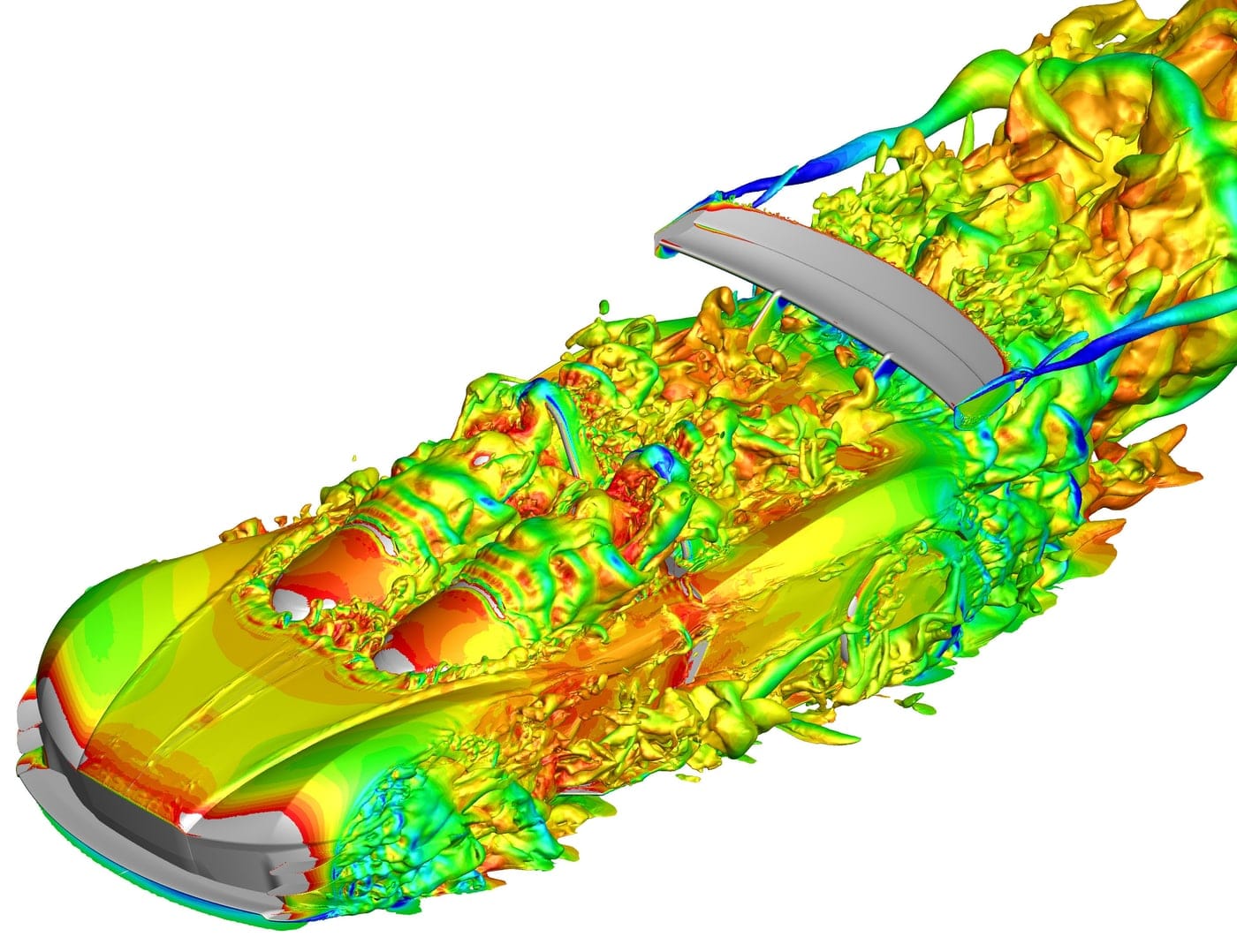
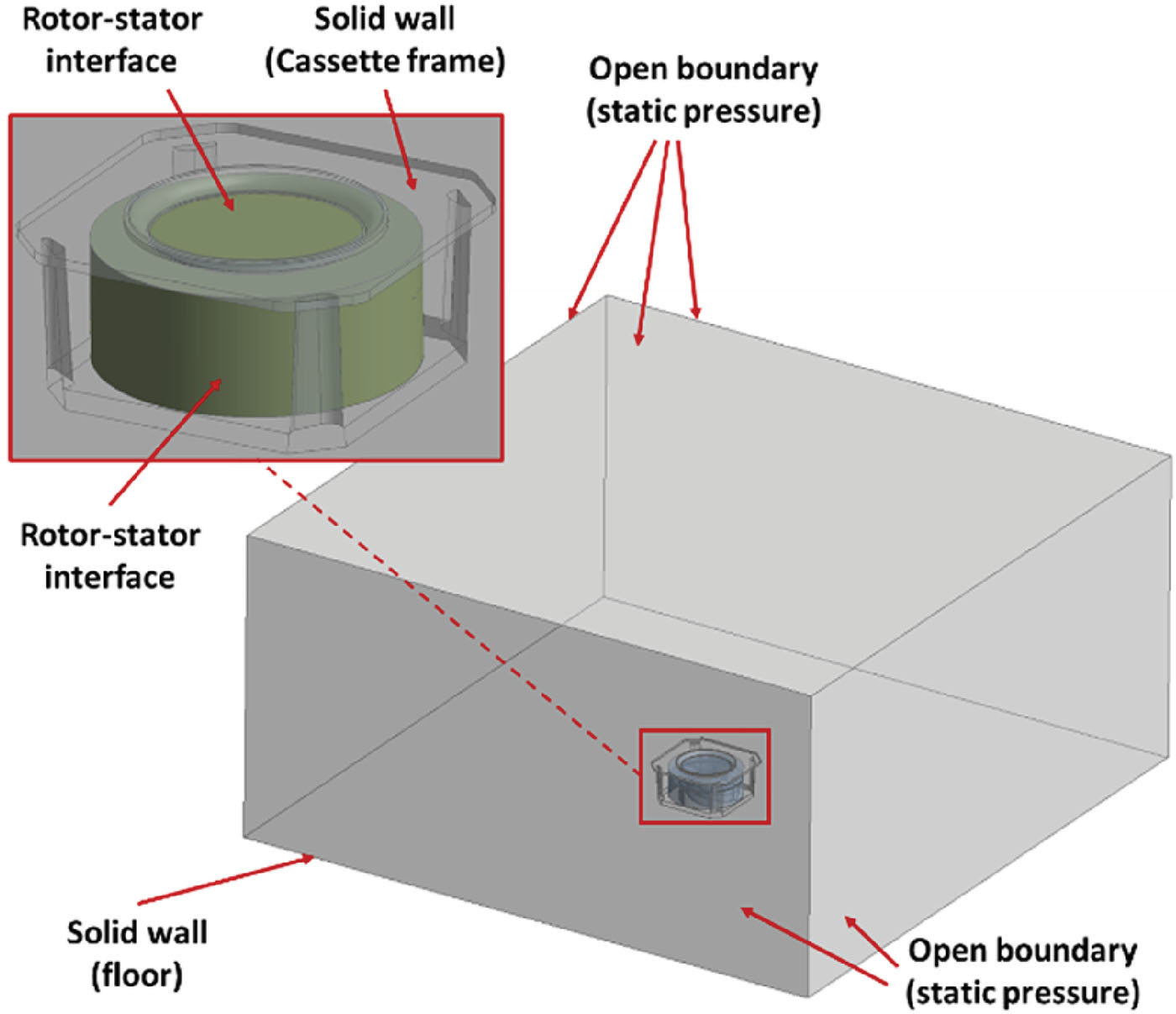
Published version, CC BY, fig. 7
Funded by
Who works on this
All of the team
Prof. David Moxey
Group leader and project leader of the Nektar++ framework.
Previously

Dr. Hamid Motamedi-Zokae
Worked with Torin-Sifan Ltd to investigate CFD-driven HVAC design.
Now: CFD Engineer, D-Tech Rotary Steerable
Dr. Mohammad Moshfeghi
Impellor design and CFD modelling in a knowledge transfer partnership with Torin-Sifan Ltd.
Now: EDU Cooling and Lubrication Lead Engineer, Jaguar Land Rover
Recent papers
All publications-
Eng. Appl. Comput. Fluid Mech., vol. 19, pp. 2585337
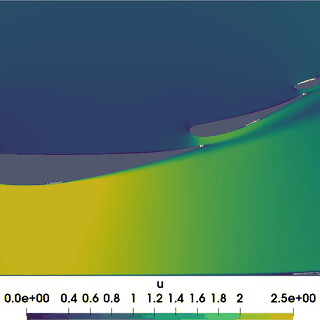
Centrifugal fans find widespread application in building ventilation and air-conditioning systems. Nonetheless, they face challenges in meeting the growing need for energy efficiency, better performance, and reduced noise levels. In this paper, we examine simultaneous aerodynamics and aeroacoustics optimization of a backward-curved centrifugal fan. The study begins with the validation of 3D computational fluid dynamics (CFD) models for both aerodynamic and aeroacoustic simulations against experimental data. Using these validated models, two separate simulation domains are employed for aerodynamic and aeroacoustics analyses, and a selection of CFD simulations performed using a Latin HyperCube sampling. Based on this data, surrogate models were trained independently to predict aerodynamic and aeroacoustics behaviour based on five geometric design parameters, including the blade flow angle distribution from leading edge (LE) to trailing edge (TE). We then perform three optimization scenarios—purely aerodynamics, purely acoustics, and combined aerodynamics-aeroacoustics using the surrogate-based NSGA-II optimization algorithm and compare the optimal results against the baseline geometry. We show that aerodynamics optimization demonstrates up to an 8% increase in efficiency within the operating range, while the acoustics optimization achieved a reduction of up to 4 dB in the maximum sound pressure level, at the expense of significantly reduced flowrates. The aeroacoustics optimization yielded a balanced outcome, maintaining baseline flowrates while delivering a 3.9% increase in efficiency and a 3.5 dB reduction in maximum sound pressure level. These results underscore the trade-offs between aerodynamics performance and acoustics behaviour and highlight the potential of optimization strategies tailored to specific operational goals.@article{zoka-2025, title = {Surrogate-based evolutionary optimization of aerodynamic performance and emitted sound for an impeller fan}, author = {Zoka, H. M. and Moxey, D. and Tabor, G.}, journal = {Eng. Appl. Comput. Fluid Mech.}, year = {2025}, volume = {19}, number = {1}, pages = {2585337}, doi = {10.1080/19942060.2025.2585337}, url = {https://www.tandfonline.com/doi/full/10.1080/19942060.2025.2585337} } -
Multi-Point Aerodynamic Optimization of a Backward-Curved Impeller Fan
Turbo Expo: Power for Land, Sea, and Air, vol. 87981, pp. V006T10A008
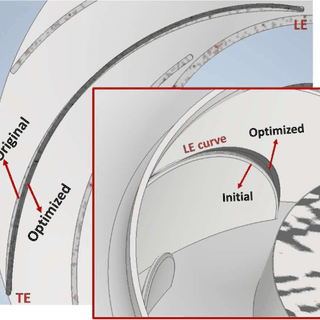
Centrifugal fans find widespread application in building ventilation and air-conditioning systems. Nonetheless, they face challenges in meeting the growing need for energy efficiency, better performance, and reduced noise levels. These limitations stem from the inherent constraints imposed by the circular arc blade design. In this paper, aerodynamic optimization of a backward-curved centrifugal fan was carried out. For this purpose, 3D computational fluid dynamics (CFD) simulations of the initial fan were first validated against test data. Then, using five geometric design parameters, the blade flow angle distribution, from leading edge (LE) to trailing edge (TE), was optimized within its operating range by means of a surrogate-based optimization technique. Efficiencies at different operating points of the fan were selected as objectives while the constraints of the optimization practice include flowrates as well as blade thicknesses of the initial geometry. The suggested optimum geometry generated from this process was independently simulated by CFD to assess the meta-model predictions. The computed results demonstrated up to a 1.7% increase in efficiency in its operating range compared to the initial model. Moreover, studying the features of the flow passing through the blades indicated an improved aerodynamic behavior with reduced separation zones for the optimized geometry compared with the initial one. Geometric comparison of initial and optimized geometries also revealed a curvature redistribution in the fan blades.@inproceedings{motamedi-2024, title = {Multi-Point Aerodynamic Optimization of a Backward-Curved Impeller Fan}, author = {Motamedi Zokae, Hamid and Tabor, Gavin and Moxey, David and Page, Martin and Stokes, Martin}, booktitle = {Turbo Expo: Power for Land, Sea, and Air}, volume = {87981}, pages = {V006T10A008}, year = {2024}, doi = {10.1115/GT2024-127168}, organization = {American Society of Mechanical Engineers} } -
Large eddy simulation of an inverted multi-element wing in ground effect
Flow Turbul. Combust., pp. 917-944
Due to the proprietary nature of modern motorsport and Formula 1, current scientific literature lacks relevant studies and benchmarks that can be used to test and validate new methods. Due to the release of a free geometry - the Imperial Front Wing - we present a computational study of a multi-element aerofoil at a ride height of 0.36h/c and a Reynolds Number of 2.2 × 10⁵. A 0.16c slice of the Imperial has been examined using high-order Spectral/hp Element Methods. Time averaged force data is presented finding lift and drag coefficients of -8.33 and 0.17 respectively. Transient analysis of the force- and surface pressure data resulted in salient mode identification with respect to the transition mechanisms of each element.The mainplane and flap laminar separation were studied and the cross-spectral phase presented for the lower frequency modes. At a St=40 an in-phase relationship was identified between mainplane and flap Laminar Separation Bubbles, whilst at St=60 a distinct out-of-phase relationship was identified. Wake results including wake-momentum deficit and turbulent kinetic energy plots have been presented - showing wake meandering and subsequent break down due to a Kelvin-Helmholtz instability. These results, particularly the transition mechanisms will allow for the construction of a data set to validate novel methods in this area.@article{slaughter-2023, title = {Large eddy simulation of an inverted multi-element wing in ground effect}, author = {Slaughter, J. and Moxey, D. and Sherwin, S. J.}, journal = {Flow Turbul. Combust.}, year = {2023}, number = {110}, pages = {917-944}, doi = {10.1007/s10494-023-00404-7}, url = {https://link.springer.com/content/pdf/10.1007/s10494-023-00404-7.pdf} } -
Spectral/hp element simulation of flow past a Formula One front wing: validation against experiments
J. Wind. Eng. Ind. Aerod., vol. 221, pp. 104832
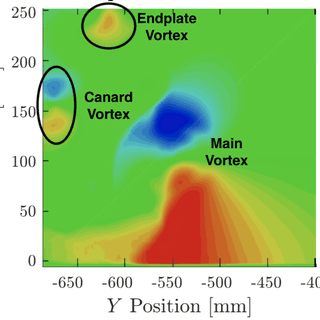
Emerging commercial and academic tools are regularly being applied to the design of road and race cars, but there currently are no well-established benchmark cases to study the aerodynamics of race car wings in ground effect. In this paper we propose a new test case, with a relatively complex geometry, supported by the availability of CAD model and experimental results. We refer to the test case as the Imperial Front Wing, originally based on the front wing and endplate design of the McLaren 17D race car.cv A comparison of different resolutions of a high fidelity spectral/hp element simulation using under-resolved DNS/implicit LES approach with fourth and fifth polynomial order is presented. The results demonstrate good correlation to both the wall-bounded streaklines obtained by oil flow visualization and experimental PIV results, correctly predicting key characteristics of the time-averaged flow structures, namely intensity, contours and locations. This study highlights the resolution requirements in capturing salient flow features arising from this type of challenging geometry, providing an interesting test case for both traditional and emerging high-fidelity simulations.@article{buscariolo-2022, title = {Spectral/$hp$ element simulation of flow past a Formula One front wing: validation against experiments}, author = {Buscariolo, F. F. and Hoessler, J. and Moxey, D. and Jassim, A. and Gouder, K. and Basler, J. and Murai, Y. and Assi, G. R. S. and Sherwin, S. J.}, journal = {J. Wind. Eng. Ind. Aerod.}, year = {2022}, volume = {221}, pages = {104832}, url = {https://arxiv.org/pdf/1909.06701}, doi = {10.1016/j.jweia.2021.104832} } -
SIAM Review, pp. 723-755
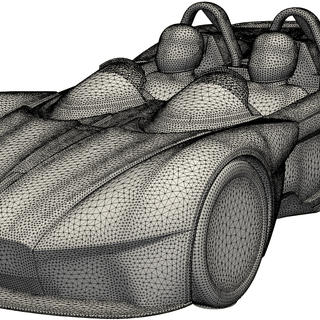
We present a successful deployment of high-fidelity Large-Eddy Simulation (LES) technologies based on spectral/hp element methods to industrial flow problems, which are characterized by high Reynolds numbers and complex geometries. In particular, we describe the numerical methods, software development and steps that were required to perform the implicit LES of a real automotive car, namely the Elemental Rp1 model. To the best of the authors’ knowledge, this simulation represents the first fifth-order accurate transient LES of an entire real car geometry. Moreover, this constitutes a key milestone towards considerably expanding the computational design envelope currently allowed in industry, where steady-state modelling remains the standard. To this end, a number of novel developments had to be made in order to overcome obstacles in mesh generation and solver technology to achieve this simulation, which we detail in this paper. The main objective is to present to the industrial and applied mathematics community, a viable pathway to translate academic developments into industrial tools, that can substantially advance the analysis and design capabilities of high-end engineering stakeholders. The novel developments and results were achieved using the academic-driven open-source framework Nektar++@article{mengaldo-2020, title = {Industry-relevant implicit large-eddy simulation of a high-performance road car via spectral/$hp$ element methods}, author = {Mengaldo, G. and Moxey, D. and Turner, M. and Moura, R. C. and Jassim, A. and Taylor, M. and Peir\'o, J. and Sherwin, S. J.}, journal = {SIAM Review}, pages = {723-755}, issue = {63}, number = {4}, year = {2021}, doi = {10.1137/20M1345359}, url = {https://arxiv.org/pdf/2009.10178} }
Collaborators
- Spencer Sherwin Imperial College London
- Gianmarco Mengaldo National University of Singapore
- Gavin Tabor University of Exeter
Interested in working on this?
We are always glad to hear from prospective PhD students and postdocs, and from groups who would like to work with us. Our openings page lists what is currently funded and the routes that are open year round.
Join us